
Introduction: A Clear Torah Duty
Yahuah (Yah) commanded Israel: set apart the bechor (firstborn) as holy (Exodus 13:2). The Yahudiym Sefer (Book of Law) shows this duty in priestly substitution and in household responsibility. This teaching lays out the TORAH COMMANDS, Yahudiym Ministries application for fathers, and later customary practices that developed. It gives concrete household steps a father and mother can use to sanctify the bechor, teach sons and daughters covenant identity, and preserve rightful inheritance and blessing.
Scripture Foundations
- Exodus 13:2 — The command: sanctify every firstborn to Yahuah.
- Numbers 3:12–13 — The Leviyim (Levites) were taken as substitutes for the firstborn of Israel and given to priestly service.
- Numbers 18:15–16 — What opens the womb belongs to Yahuah; such firstborn are to be redeemed (pidyon haben; “redemption of the son”).
- Deuteronomy 21:15–17 — The father’s duty regarding inheritance: the firstborn son must receive his birthright portion and not be denied because of the father’s preference.
- Genesis 49:1–28 — The father’s birkat (blessing) for sons: Jacob’s recorded blessings show the father’s covenant responsibility in words that shape tribal mission and inheritance.
Distinguishing TORAH COMMAND, MINISTRY APPLICATION, and LATER CUSTOM
TORAH COMMAND — Yahuah commands that the bechor be sanctified and that the redeemed firstborn be given over by their father (Exodus 13:2; Numbers 18:15–16). The command is concrete: firstborn are set apart and require redemption or substitution as the Torah prescribes.
MINISTRY APPLICATION — Yahudiym Ministries instructs that the father leads the household in plain, public observance: the father states the son’s firstborn status, carries out the redemption as the assembly requires, and gives the birkat (blessing) over sons and daughters according to Torah order. In mixed teaching or when a public form is required, the adult Israelite man of office (kohen or elder Israelite man) should serve in the assembly role.
LATER CUSTOM — Specifics such as the commonly practiced thirty-day timing for pidyon haben and later ceremonial formulas are not laid down as a Torah command. These are later customary forms. Fathers must keep Torah commands distinct from local custom and consult the assembly’s man of office (kohen or elder Israelite man) when a ceremonial form is needed.
Key Hebrew Terms (with English equivalents)
- Bechor (firstborn) — the very first son to open the womb.
- Pidyon Haben (redemption of the son) — the act of redeeming the firstborn who is sanctified to Yahuah.
- Birkat (blessing) — the father’s covenantal blessing pronounced over sons and daughters.
- Leviyim (Levites) — the tribe set apart to serve in place of the firstborn.
- Torah (Law or Instruction) — the instruction given by Yahuah to Israel, recorded in the Yahudiym Sefer (Book of Law).
- Kohen (priest) — the man of priestly office who serves at the altar and in assembly rites when present.
Step-by-Step Household Practice: Honoring the Bechor
1. Affirm the TORAH COMMAND
The father plainly affirms: “This bechor is sanctified to Yahuah.” Read Exodus 13:2 to the household. The father’s declaration roots the household act in Torah command and makes clear that the obligation rests on the father as head of household.
2. If the household is Leviyim (Levites) or a Levite son is born
Numbers 3:12–13 explains the Leviyim substitution. If the father belongs to the tribe of Levi or the son is Leviyi, record that the son is dedicated to service according to assembly practice and Torah instruction. The father’s household must follow the assembly’s established way of recognizing Leviyim service.
3. Redemption (Pidyon Haben): Household Procedure (Torah duty and customary form)
- TORAH duty — The father must redeem the firstborn because what opens the womb belongs to Yahuah (Numbers 18:15–16). The father acknowledges the obligation before the household.
- LATER CUSTOMARY FORM — Many assemblies present the babe to a kohen (priest) or an assembly elder Israelite man in an appointed gathering and transfer a redemption value of money. The commonly taught timing (often thirty days) and specific ceremonial words are later custom, not a Torah command. Fathers should adopt the assembly-approved timing and wording when an elder advises it.
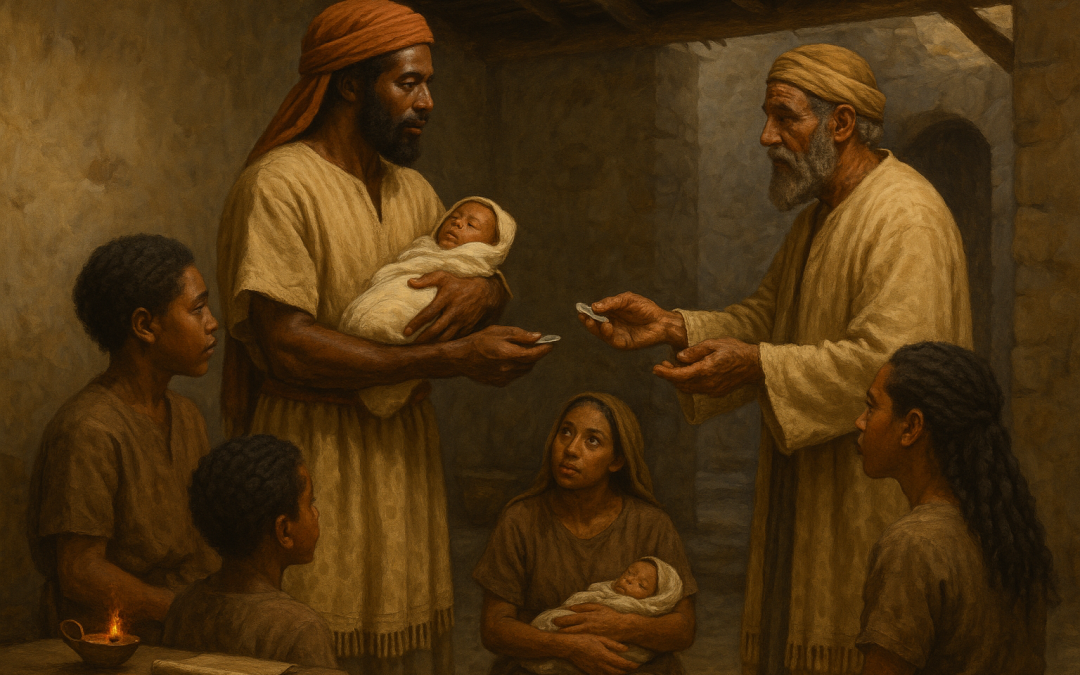
- Practical steps — The father brings the babe before the kohen or designated elder Israelite man; the father states the babe’s name and firstborn status; the father gives the agreed sum or assembly token; the kohen or elder accepts and gives a short acknowledgement that recognizes Yahuah’s claim and the redemption.
If no kohen is available, the father consults the assembly elder Israelite man. The father keeps a household record of the act as testimony of obedience.
4. Birkat (Blessing) and Inheritance
- Prepare — The father prepares to bless his sons and daughters. He studies Genesis 49 and Deuteronomy 21 to know his responsibility.
- Give the birkat — The father speaks the blessing aloud in the household presence. The blessing names the son or daughter, declares Yahuah’s covenant promises for them, and, when appropriate, assigns the birthright portion according to Deuteronomy 21:15–17.
- Confirm inheritance — The father must not deny the firstborn his lawful portion because of partiality. If the father prefers a younger son, he still must grant the firstborn his birthright portion as Torah requires.
Household Documents and Records
The father may keep a short written household record: date of birth, notation that the son is a bechor, record of redemption (who received the money or token), and a copy of the father’s written birkat if he chooses to record it. The mother may keep a copy. These notes serve as household testimony and teach sons and daughters their covenant place. They are not modern legal contracts.
Pastoral Questions and Clear Answers
Q: If the father prefers a younger son — can he deny the firstborn his portion?
A: No. Deuteronomy 21:15–17 commands the father to give the firstborn his lawful portion regardless of personal preference. The father must obey Torah.
Q: When must the pidyon haben occur?
A: TORAH requires redemption (Numbers 18:15–16) but does not set a precise timetable. The commonly practiced thirty-day timing and exact ceremonial formulas are later custom. The father should consult the kohen or the assembly elder Israelite man to determine the assembly-approved timing and form.
Q: If a household cannot access a kohen, what then?
A: Consult the assembly elder Israelite man. The father must still redeem the bechor in a manner recognized by the assembly. Keep a faithful household record of the act.
Simple, Sober Household Observances to Teach Covenant Identity
Use plain observances that teach obedience rather than spectacle. Examples:
- Household reading — At the table, the father reads Exodus 13:2 aloud and places the babe in the mother’s lap. The father states: “This bechor is set apart to Yahuah.”
- Redemption presentation — In front of close household members and an elder Israelite man, the father presents the babe, names the babe, states he redeems the bechor, hands the money or assembly token to the kohen or elder, and receives a short acknowledgement.
- Blessing circle — The father calls the sons and daughters, gives each a short birkat tailored to covenant promises and a calling. The mother encourages and instructs the younger ones in the household ways.
Discussion Prompts for Household Teaching Time
- Read Exodus 13:2 together. Ask: What does it mean for our household that the firstborn is sanctified to Yahuah?
- Read Numbers 3:12–13. Ask sons and daughters: How did the Leviyim serve our people in place of the firstborn? What does service look like today?
- Read Deuteronomy 21:15–17. Ask the household: How must a father act when his heart prefers one son over another?
- Read Genesis 49:1–28. Ask: Which parts of Jacob’s birkat point to tribe and mission? How should the father’s birkat point sons and daughters to covenant calling?
Closing Charge
Fathers: lead. The father and mother together must teach sons and daughters the Torah command plainly, redeem the bechor as Torah requires, honor the Leviyim pattern where it applies, and give the birkat in truth. Keep Torah commands distinct from later custom: consult the kohen or the assembly elder Israelite man when ceremonial form is needed. Keep the household record. Let obedience, not show, mark your honoring of the bechor so the next generation knows its covenant place under Yahuah and follows Torah instruction faithfully.
Scripture references used: Exodus 13:2; Numbers 3:12–13; Numbers 18:15–16; Deuteronomy 21:15–17; Genesis 49:1–28. These references are cited from the Yahudiym Sefer (Book of Law) as the source of command and instruction.