
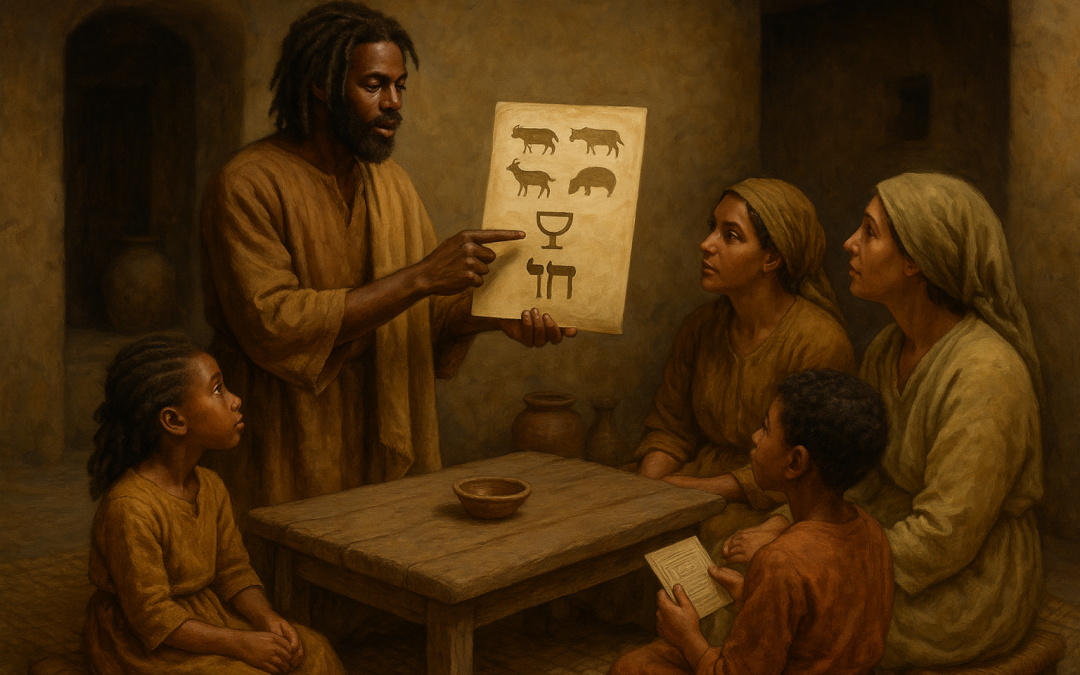
Introduction: Covenant Teaching at the Household Table
Fathers and mothers teach in their households from the Yahudiym Sefer (Book) of the Law about why dam (blood) and nefesh (life) are sacred. Elders (men) serve the assembly teaching role and should be described and called upon separately from household responsibility. The Torah (Law or Instruction) links provision and the limits on its use. This guide gives plain explanations of key passages (Genesis 9:3–4; Leviticus 7:26–27; Leviticus 11:1–47; Leviticus 17:10–14; Deuteronomy 12:15–25), household practices for eating meat, and activities for the household that teach gratitude, obedience, and respectful handling of meat. Use the father-first household order: fathers and mothers teach; elders (men) serve the assembly role.
Why dam (blood) and nefesh (life) are sacred — simple explanations
Genesis 9:3–4 shows that after the Flood an allowance for eating animals was given, but Yahuah (Yah) placed limits. Leviticus 17:10–14 states the theological point the Torah makes plainly: the nefesh (life) of the flesh is in the dam (blood), and the blood is reserved for the altar and sacred purposes. Leviticus 7:26–27 and Deuteronomy 12:15–25 forbid eating dam (blood) and require proper dealing with blood when an animal is slaughtered.
Explained to sons and daughters: the red liquid called dam (blood) is connected to nefesh (life). Because nefesh (life) is Yahuah’s (Yah’s) gift, the Torah commands: do not eat dam (blood). Treat the life of animals with reverence and remember that food is a provision Yahuah gives.
How these passages fit together
- Provision with limits (Genesis 9:3–4): Yahuah permits using animals for food but sets limits.
- Life in the blood (Leviticus 17): The Torah teaches that the nefesh (life) of flesh is in the dam (blood); the blood is reserved for the altar and is not to be eaten.
- Clean and unclean (Leviticus 11): The Torah lists animals that are permitted and forbidden and gives signs for permitted land animals, fish, and certain insects; these form a pattern for holy living.
- Household handling (Deuteronomy 12): The Torah gives instructions about where and how offerings and meat are to be handled and how to deal with dam (blood) responsibly.
Teaching sons and daughters: age-appropriate truths and household conversation starters
When explaining to young ones, keep language concrete and non-graphic. Focus on gratitude, respect, and obedience to the Torah command.
- Simple household statement: “The Torah says do not eat dam (blood) because dam (blood) shows the animal had nefesh (life). Nefesh (life) belongs to Yahuah (Yah), so we do not eat the blood.”
- Use visual aids: a picture of a household sharing a meal, a small scroll image labeled Torah (Law or Instruction), and a simple chart of signs for permitted animals.
- Household discussion prompts:
- Why does Yahuah want us to respect nefesh (life)?
- How can we show gratitude when we eat meat? (Thanking Yahuah, remembering the work that brought the food to the table.)
- How does remembering offerings in the Mishkan (Tabernacle) help us be more thankful today?
Teaching about permitted animals (Leviticus 11)
Keep this simple for the household. Explain the basic signs the Torah gives so sons and daughters can recognize common foods without turning the lesson into a long list.
- Land animals: The Torah gives signs—chewing the cud and having split hooves—for permitted land animals (for example, sheep and cows are common household identifications of animals the Torah allows). Do not present modern names as if the Torah explicitly listed each modern species.
- Fish: The Torah’s sign is fins and scales for permitted fish; shellfish and fish without scales are not listed as permitted.
- Birds and insects: The Torah lists particular birds and identifies certain locusts; for household teaching, use common household identifications (for example, chicken as a common household bird) while noting that the Torah names specific birds rather than modern species names.
Clear, non-graphic kitchen practices
Teach and model respectful, Torah-consistent handling of meat in the household. Avoid graphic detail when instructing young ones; state purpose and obedience.
- Purchase and sourcing: Acquire meat from a known source or a butcher who understands Torah requirements. For many households, the father, a trained adult Israelite man, or an elder (man) called to assist may oversee slaughter and initial handling; women and other household members may assist under his direction.
- Slaughter and supervision: Slaughter is a serious household matter and should be done by the father, a trained adult Israelite man, or an experienced elder (man). Sons and daughters may be taught from a distance or by explanation; when mixed-group instruction is given, an adult Israelite man should lead the teaching consistent with assembly standards.
- Removing and not eating dam (blood): Follow the Torah’s command not to eat dam (blood). Leviticus and Deuteronomy instruct that blood is to be poured out on the earth when the Torah requires it. In household kitchens the common practical methods are draining and, when safe and appropriate, rinsing the meat. Some later community methods—such as salting and soaking—have been used as practical steps to remove surface blood; teach these as household practices or later customary methods, not as Torah commands.
- Cleanliness and safety: Keep cooking areas clean, wash hands, and supervise young ones in the kitchen. Teach respect for nefesh (life) together with food-safety practices.
- When eating outside the household or in mixed kitchens: Teach sons and daughters to ask respectful questions about how meat was prepared. If the household cannot confirm proper handling of dam (blood), prefer foods that meet the household’s standards or choose permitted fish (fins and scales), legumes, and vegetables.
Household practices to teach obedience and gratitude
Regular household practices will root the Torah teaching in daily life.
- Meal-time practice: Teach a short, age-appropriate blessing or expression of thanks to Yahuah (Yah) as a household custom. Note: Deuteronomy 8:10 speaks of blessing Yahuah after eating and being full; a pre-meal blessing is a household practice unless a specific Torah text commands it for the meal form you use.
- Storytelling: Use Torah stories—Noach (Noah) and the post-Flood allowance and limits (Genesis 9), the sacrificial system in Leviticus, and the laws in Deuteronomy—to explain the reasons for the commands and to teach gratitude and restraint.
- Supervised visit / guest teaching: Invite an elder (man) or a knowledgeable butcher to explain the non-graphic reasons for the practices and to demonstrate respectful handling. Ensure an adult Israelite man leads mixed-group teaching where assembly standards require it.
- Role-play and simple songs: Short role-plays about giving thanks or songs that teach respect for nefesh (life) help young ones internalize the lesson.
- Service and care: Involve sons and daughters in feeding the hungry or caring for animals in humane ways to reinforce compassion along with obedience to the Torah.
Closing exhortation
Teaching sons and daughters about dam (blood) and nefesh (life) is not only about rules; it is about teaching obedience to Yahuah (Yah), keeping covenant, and showing compassion. Explain the Torah plainly, model respectful household practices, and make gratitude part of the household table so the next generation learns obedience to the Torah and the proper handling of nefesh (life). Encourage questions, teach reverence for life as the Torah requires, and follow the pattern of offerings and thanksgiving that directs the household toward obedience and mercy in every generation.
May Yahuah (Yah) grant wisdom to fathers and mothers as they teach in their households, and grant wisdom to elders (men) who teach in the assembly; may the example of such household and assembly leaders guide our steps in covenant faithfulness.