
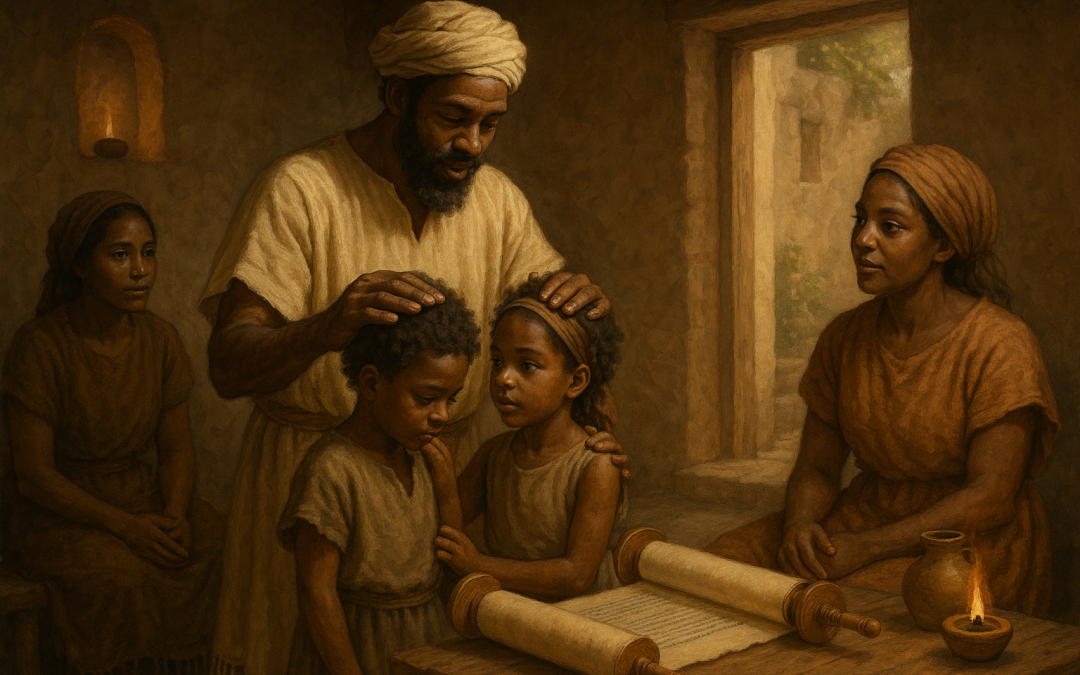
Introduction: Why Restore Berakah (Blessing) in the Home?
Blessing (Hebrew: berakah, ברכה — “blessing”) is foundational to covenant life under El Elohiym (the One Creator God). The Yahudiym Sefer (Book) of Law teaches that words of blessing carry covenant power (see Numbers 6:24–26). In our families we are called to speak life, teach Torah (Law or Instruction), and pass down Yahuah’s (Yah’s) ways to the next generation (Deuteronomy 6:6–7). This teaching offers a practical, reverent guide to reintroducing household benedictions—drawing on the Birkat Kohanim (Priestly Blessing) and the patriarchal examples of Genesis 27 and Genesis 48—so that parents may bless their children and households in a manner faithful to Scripture, humble before authority, and instructive for children.
The Theological Basis: Numbers 6:24–26 and the Nature of Berakah
Numbers 6:24–26 is the classical text for the Birkat Kohanim (Priestly Blessing). The Torah presents berakah as an invocation of Yahuah’s favor, protection, presence, and shalom (peace) upon the people. Read Numbers 6:24–26 in your Yahudiym Sefer for the full context. The blessing’s themes are simple and profound: blessing (favor), guarding (protection), shining presence (divine countenance), and peace.
See Numbers 6:24–26 (Birkat Kohanim) for the canonical wording of the priestly blessing.
Berakah is not merely a warm expression; it is a covenant speech-act. When El Elohiym’s Name is invoked, we call upon the Creator’s covenant relationship and promise. Thus parents, as covenant leaders in their homes, may restore daily benedictions that call upon Yahuah’s covenant faithfulness.
Patriarchal Models: Genesis 27 and Genesis 48
We find household blessing-models in the lives of the patriarchs. In Genesis 27:27–29 Isaac (Yitzchak) bestowed a blessing on Jacob (Ya‘akov), invoking God’s abundance, dominion, and nourishment. In Genesis 48:15–16 Jacob blesses Joseph’s sons, invoking El Elohiym who was with him, calling upon the Name of the Most High to bless the boys and their descendants. These examples show fathers speaking covenant words, calling on Yahuah’s presence and promise to shape family destiny.
Understanding Birkat Kohanim (Priestly Blessing)
Birkat Kohanim (Priestly Blessing) — Hebrew: בִּרְכַּת הַכּהֲנִים — is Torah-rooted. Traditionally, it is given by the kohanim (priests), descendants of Aharon (Aaron). The text of Numbers 6:24–26 in Hebrew (common form used in prayer) and a transliteration are provided below for household use and teaching. Parents should read the pastoral cautions that follow before adopting the priestly form.
Hebrew, Transliteration, and English (Birkat Kohanim)
Hebrew: יְבָרֶכְךָ יְהוָה וְיִשְׁמְרֶךָ
יָאֵר יְהוָה פָּנָיו אֵלֶיךָ וִיחֻנֶּךָּ
יִשָּׂא יְהוָה פָּנָיו אֵלֶיךָ וְיָשֵׂם לְךָ שָׁלוֹם
Transliteration (with Name rendered as Yahuah):
Yevarechecha Yahuah ve’yishmerecha.
Ya’er Yahuah panav eileicha ve’yichuneka.
Yisa Yahuah panav eileicha ve’yasem lecha shalom.
English (literal sense):
May Yahuah bless you and keep you.
May Yahuah cause His face to shine upon you and be gracious to you.
May Yahuah lift up His face upon you and give you shalom (peace).
Practical, Reverent Household Liturgy
Below is a simple household liturgy parents may use. Adapt with humility and according to pastoral cautions. Keep words brief, clear, and Scripture-rooted.
Basic Weekday Blessing (Evening or Bedtime)
- Parent stands or sits near the child, places hands gently on the child’s head or shoulder with reverence.
- Say: “By the covenant of El Elohiym, I speak blessing over you.”
- Speak a short blessing such as: “May Yahuah bless you and keep you. May Yahuah give you wisdom, strength, and heart to love Torah. In Yahshua/Yahshua-haMashiach (Jesus), be bold to walk in covenant ways.”
- Close in short prayer and a sign of affection (embrace, kiss, or a simple ‘amen’).
Shabbat (Sabbath) Variation
On Shabbat evening or morning, parents may lengthen the blessing with Sabbath language:
“On this Shabbat (Sabbath), I bless you in the Name of Yahuah: may His presence rest upon this home; may you walk in Torah and love; may you know rest and shalom.” Optionally recite the Birkat Kohanim (see above) slowly in Hebrew, then repeat the English sense.
Feast-Day (Moed) Variation
On appointed times (moed — festivals), invoke the festival theme: Passover—deliverance; Shavuot—Torah and heart; Sukkot—provision and shelter. Conclude with the Birkat Kohanim phrasing or a short Scripture-based phrase.
Step-by-Step Instructions
- Prepare: parents repent and align with Torah; ask forgiveness where needed. Blessing must flow from covenant integrity.
- Set a regular time: morning departures, bedtime, Shabbat, and festivals. Deuteronomy 6:6–7 instructs us to make Torah talk regular—teach while sitting, walking, lying down, and rising.
- Physical posture: respectful and gentle. No showy displays. Touch is pastoral—hands on shoulders or head in humility.
- Speak Scripture-rooted words: short, clear, and covenantal. Avoid claiming priestly office if you are not a kohen.
- Teach children to respond: say “amen,” repeat a phrase, or pray a short reply.
Pastoral Cautions About Authority and Humility
The Birkat Kohanim in Numbers is given by kohanim (priests). The Torah prescribes priestly roles and lineage. Parents should not assume a priestly office they do not possess or perform the ritual as if they were acting in the Temple function. Instead, parents may adopt the form and language of blessing as loving covenant representatives who call upon Yahuah’s Name for their children, always with humility. Avoid public elevation, claim of spiritual superiority, or using blessing as control. Seek elder or rabbinic counsel if uncertain about liturgical or communal boundaries.
Teaching Children: Using Deuteronomy 6:6–7 as a Framework
Deuteronomy 6:6–7 instructs parents to keep Torah in their hearts and teach it diligently to children. Use these simple practices:
- Repeat short memorized blessings daily (bedtime, before a meal, Shabbat). Repetition builds covenant memory.
- Explain the meaning: teach that berakah calls on Yahuah’s favor, presence, and protection.
- Use stories: read the patriarchal blessings (Genesis 27 and Genesis 48) and discuss how fathers spoke God’s promises.
- Role-play: have children bless one another with permission and guidance to learn the posture and words of respectful benediction.
- Make it communal: invite grandparents or elders to model blessing when appropriate.
Conclusion
Restoring household benedictions is a simple, powerful way to reclaim covenant life. Grounded in Numbers 6:24–26 and modeled by the patriarchs, household blessings can form the daily rhythm of a Torah-centered home. Do so with reverence, humility, and obedience to El Elohiym. Teach children with consistency, devotion, and the methods of Deuteronomy 6:6–7 so that the next generation receives the blessing of Yahuah.
Scripture references: Numbers 6:24–26; Deuteronomy 6:6–7; Genesis 27:27–29; Genesis 48:15–16. Consult your Yahudiym Sefer for full readings and context.