
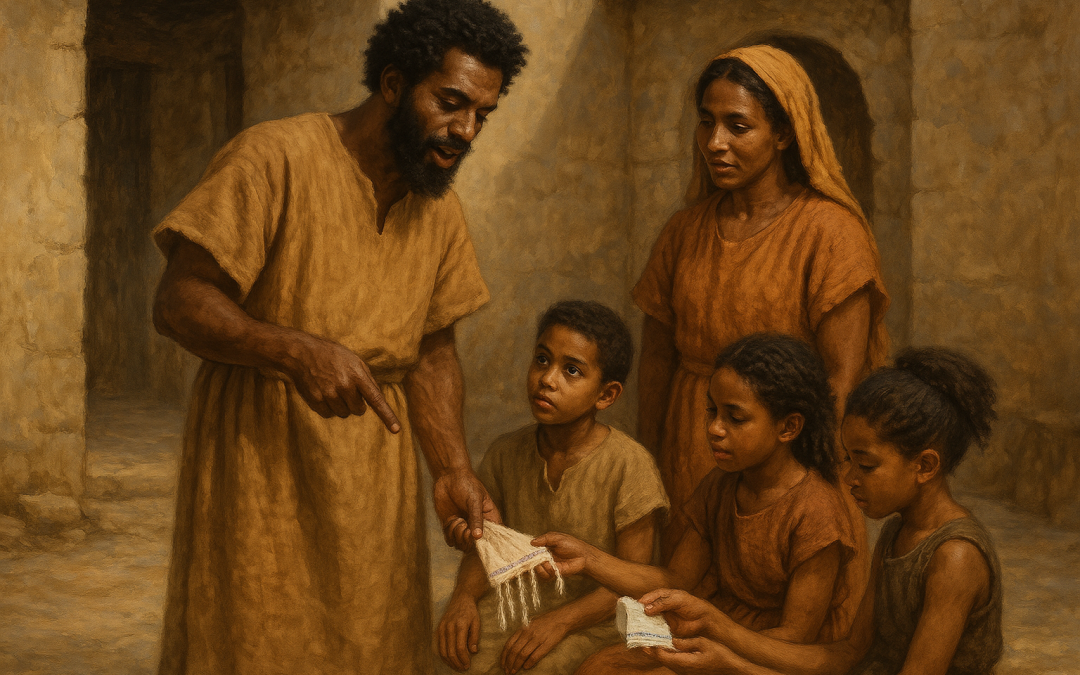
Introduction: A Visible Sign for a Household
The Torah (Law or Instruction) commands tzitzit (fringes) on the corners of garments as a visible sign that keeps covenant teaching present in daily life. In Numbers 15:37–41 and Deuteronomy 22:12 the instruction is plain: place fringes on the four corners of your garment; when you see them remember the commandments and do them. This teaching is for fathers and household leaders who must teach the next generation to remember Yahuah (Yah) and keep covenant fidelity.
Plain Sense of the Texts
Numbers 15:37–41 (paraphrase): The people are told to make tzitzit (fringes) on the corners of their garments with a cord of tekhelet (blue). When a man sees the fringes, he will remember all the commandments and do them, and not follow his heart or eyes leading to sin; so that he may remember and be holy to El Elohiym (the Creator). Additionally the text reminds Israel that Yahuah (Yah) brought them out of Egypt—connecting remembrance of redemption to obedience.
Deuteronomy 22:12 states: Make tzitzit (tassels/fringes) on the four corners of the garment and put a cord of tekhelet (blue) on the tassel.
These verses establish the tzitzit as a covenantal, pedagogical device: a visible cue that trains memory, prompts obedience, restrains sinful inclinations, and points back to Yahuah’s saving acts.
The Four Covenant Purposes Named in Scripture
- Remember the commandments. The sight of tzitzit is meant to call memory to the Torah and its requirements.
- Do the commandments. Remembrance is not abstract; it is meant to produce practical obedience.
- Do not follow the heart and the eyes. The tzitzit help restrain impulses that lead to disobedience, idolatry, and wayward living.
- Be holy to El Elohiym and remember the Exodus. The fringes remind Israel of set-apart life before Yahuah and of deliverance from Egypt as the basis of covenant duty.
Note on Tekhelet (Blue) and Later Practice
Deuteronomy 22:12 explicitly mentions tekhelet (blue) on the cord of the tassel. The Torah commands a blue cord. The precise ancient dye source and method became uncertain in later centuries; attempts to identify authentic tekhelet are later community work. Distinguish these points:
- Torah command: fringes and a thread of blue belong on the corners of garments.
- Later or customary practice: the historical identification of tekhelet and how communities recover it are later developments and should not be presented as replacing the Torah command.
Teaching Sons and Daughters at Age-Appropriate Levels
Fathers lead household instruction. Below are ways to introduce tzitzit at different ages without ritualizing the sign.
- Babes and little ones (sucklings, little ones): Use a soft fringed cloth or small corner cloth. Let the little one touch the fringe while the father names Yahuah (Yah) and says a short phrase: “This reminds us of Yahuah.” Keep it simple and tactile.
- Preschool/early youth: Tell the Exodus story briefly and show how the tzitzit remind us to obey. Use a short question: “What does this remind us to do?” Encourage a one-sentence answer: “Love Yahuah and obey Torah.”
- Older youth and teens: Read Numbers 15:37–41 and Deuteronomy 22:12 together from the Yahudiym Sefer (Book) of Law. Discuss how seeing the fringe should change decisions in real situations—school, work, friendships.
Short Household Scripts and Questions
Fathers can use these brief scripts at table, before leaving the house, or during daily Shema practice (Deuteronomy 6:4–9):
- Remember the commandments: Father points to tzitzit: “When you see this fringe, what are you to remember?” Pause for son/daughter answer. Follow: “Remember to do the commandments Yahuah gave.”
- Do the commandments: Father: “Name one thing you can do today because the Torah tells you.” Ask for a specific action—honor mother, speak truth, refuse theft, etc.
- Do not follow heart and eyes: Father: “What might your heart or eyes want you to do that breaks Torah? If you feel that, what will the fringe remind you to do?”
- Be holy and remember deliverance: Father: “Who brought us out of Egypt? How does remembering that make us act differently?” Encourage the son/daughter to say: “I will live set apart for Yahuah.”
Practical, Gentle Household Practices
Keep tzitzit as a sign, not an amulet. Suggestions for home use:
- Wear modestly and respectfully: Place fringes at the outer corners or hem as the Torah directs. Fathers model the practice; youth learn by example.
- Storage: Fold fringed garments so the corners with tzitzit are visible and not crushed; store them where they are respected, not tossed with dirty laundry. Teach sons and daughters to treat the garment with reverence as a sign of covenant, not superstition.
- Sleeping and bathing: Remove fringed outer garments for sleep or bathing if doing so keeps the household from turning the tzitzit into an object of superstition; explain the reason to the youth.
- Repair and care: Repair damaged fringes promptly and explain to sons and daughters that caring for the fringe is caring for the sign that calls us to obedience.
Connecting Tzitzit Teaching to the Shema and Daily Obedience
The Shema (Deuteronomy 6:4–9) commands fathers to teach Torah diligently. Use the tzitzit as a physical cue during Shema recitation: before saying the Shema, have the son or daughter touch the fringe and say aloud a short commitment: “We love Yahuah and will do His commandments.” This links the verbal confession with a visible, repeated reminder.
Teach practical obedience: when a son or daughter faces a choice—truth vs. lying, greed vs. giving, anger vs. restraint—ask them to look at the fringe and choose the action that honors Yahuah. The tzitzit is effective only when it trains concrete acts of obedience in daily life.
Guard Against Ritualizing; Emphasize Remembrance and Instruction
Do not present tzitzit as a magic protection or a status symbol. The Torah presents them as memory devices tied to covenant duty. Fathers must teach purpose: the fringe is to call the heart back to Torah and to the God who delivered Israel. When sons or daughters marvel at the fringe, redirect wonder toward the One it points to—Yahuah—and toward practical choices that show covenant fidelity.
Conclusion: A Father’s Responsibility
Fathers are charged in the Torah and by tradition to teach the next generation. Tzitzit (fringes) are a simple, visible tool in that work—plainly commanded in Numbers 15:37–41 and Deuteronomy 22:12—to call Israel back to remembering, doing, restraining sinful impulses, and living set apart to El Elohiym. Use the fringe as a teaching cue, bind the teaching to the Shema, train sons and daughters with brief scripts and questions, and practice gentle household care so the tzitzit point always to covenant obedience rather than superstition.
“Make tassels on the four corners… and put upon the tassel a cord of blue; so you shall look upon it and remember all the commandments of Yahuah and do them.” — Numbers 15:37–41 (paraphrase)
For fathers: begin each day with a brief reminder, teach by example, and make the tzitzit a living sign that trains sons and daughters to obey the Torah in the way they speak, work, and live. This is covenant instruction for a household that honors Yahuah.