
Introduction: Covenant Firstfruits in the Household
The Torah (Law or Instruction) commands the bringing of the first of the harvest as a testimony before Yahuah (Yah). Bikkurim (Firstfruits) ties the land’s produce to covenant memory and to care for those who serve. Yahudiym Ministries presents this household method so fathers can obey the Torah command, teach the sons and little ones the Deuteronomy declaration, and observe the count from Pesach (Passover) to Shavuot (Pentecost) in a way that preserves the Torah intent while recognizing the Mishkan (Tabernacle) and Temple do not stand now.
The Torah Basis — what Torah commands
Read these Torah passages as the command foundation: Deuteronomy 26:1–11 (the obligation to bring Bikkurim and make the declaration), Leviticus 23:10–11 (the wave-sheaf/omer offering and the count), Exodus 23:19 and Exodus 34:26 (bring the first of the firstfruits). These Scriptures bind the agricultural act to covenant remembrance and to provision for the Levite and the needy.
Key Torah points
- Bikkurim (Firstfruits): bring the first of the produce and present it before Yahuah (Yah) as the Torah commands.
- Deuteronomy 26 requires the declarative testimony when bringing firstfruits: remember the fathers’ affliction, recall Yahuah’s deliverance, and give the first of the produce as an offering to the priest or Levite where Torah provision allows.
- Leviticus 23:10–11 connects the sheaf/omer offering to Sefirat HaOmer (Counting of the Omer) that leads to Shavuot (Weeks/Pentecost).
Household Order and Office: who teaches and who serves
The father is the household’s primary Torah teacher and the one who leads the bringing and declaration of Bikkurim. The mother supports preparation, brings the little ones into participation, and assists in distribution and hospitality within the household order. Elders are men in the assembly who teach publicly or represent the assembly. Do not conflate household leadership with the elder’s male office in the assembly. Adult Israelite men and elders hold public teaching responsibility; in the house the father leads.
Yahudiym Ministries — Household Observance (application, not a new Torah command)
Where Torah commands cannot be met exactly because the Mishkan (Tabernacle) and Temple do not stand, Yahudiym Ministries offers a simple household observance that preserves the Torah intent: symbolic presentation, the Deuteronomy declaration taught by the father, and proper distribution to Levites or the needy. This household method is an application of Torah duty, not a replacement for Temple service.
Practical Household Observance — step-by-step (Yahudiym Ministries application)
- Prepare Bikkurim (Firstfruits) — the father selects a small basket with the earliest produce available: grain heads (early barley or wheat if present), figs, dates, or a modest cluster of fruit. The father labels the basket “Bikkurim (Firstfruits).”: This is a symbolic offering that follows the Torah command to bring the first of the fruit.
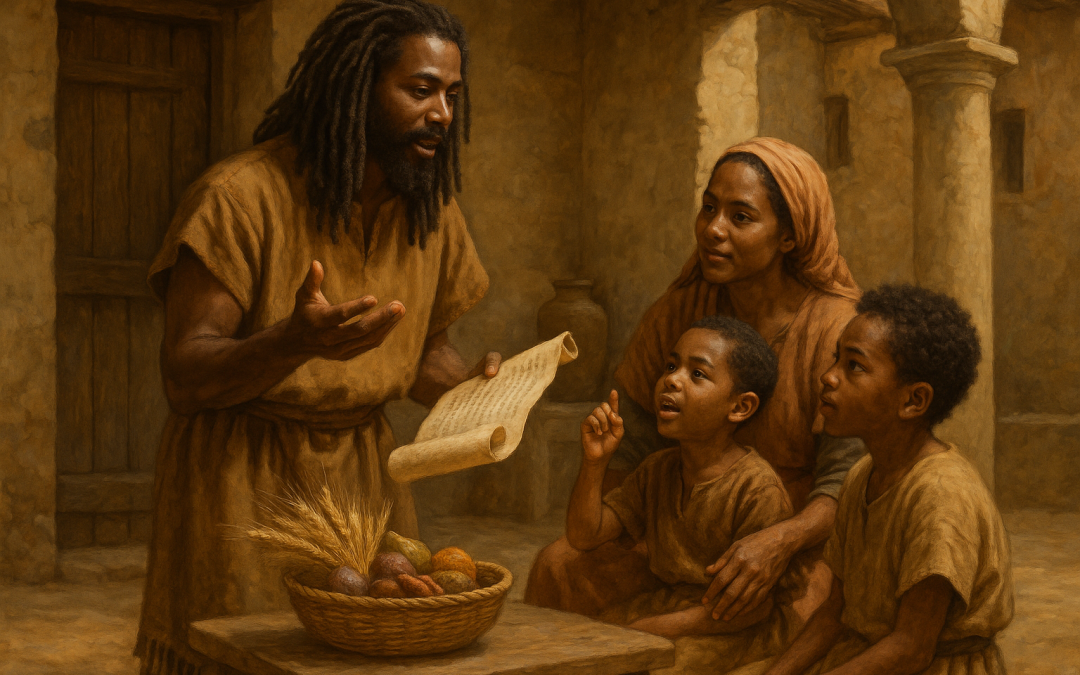
- Assemble the household in order — the father assembles the household in this household order: father first, mother next, then the sons and the little ones. The father places the basket where everyone assembled in the household can see.
- Read the Torah passages — the father reads Deuteronomy 26:1–11 aloud for the household. Then read Leviticus 23:10–11 and Exodus 23:19 / Exodus 34:26 for context. These citations are the Torah command foundation; read them from the Yahudiym Sefer (Book) of Law.
- Teach and lead the Deuteronomy declaration (paraphrase for household teaching) — the father leads the household in this paraphrase of Deuteronomy 26:5–10 as a faithful testimony (labelled paraphrase):
“Father: I declare before El Elohiym (God/Creator) and before you, my household: my father was a wandering Aramean who went down to Egypt; there we became a great people. Then Yahuah brought our fathers out of Egypt with a strong hand and great signs. He gave us this land flowing with milk and honey. Now I bring the first of the fruit of the ground that Yahuah has given me.”
The father asks the sons to repeat each line until they learn the words and the meaning. This teaching is the household’s instruction, not a new Torah wording; it follows the Torah requirement to make the declaration when bringing Bikkurim.
- Present the basket symbolically — the father lifts the basket and offers a short thanksgiving to Yahuah (Yah), acknowledging El Elohiym as the giver. If a priest or Levite is present as the Torah envisages, the father gives the basket according to the Torah command. Where no priest or Levite is accessible, follow the household distribution below to honor the Torah intent.
- Distribute according to Torah intent — Deuteronomy 26 directs portions for the priest/Levite and for the needy. If a Levite is known and present, give the Levite portion. If no Levite is accessible, set the Levite portion or its value aside and preserve it until it can be delivered to a Levite; if delivery to a Levite is impossible, distribute that portion or its monetary equivalent to needy households in the town and state clearly that this is a household adaptation, not a substitution for the Levite’s Torah allotment. This adaptation is a household application to preserve Torah intent, not a Torah command altering Temple practice.
Teaching the sons the verbal testimony
Train the sons to recite the paraphrased declaration line by line until they can state the testimony without prompting. Emphasize these concrete Torah points: we were once strangers in a foreign land; Yahuah delivered our fathers by His hand; Yahuah gave us the land and the harvest; we bring the firstfruits as thanksgiving and to support the Levite and the needy.
Counting to Shavuot — Sefirat HaOmer (Counting of the Omer)
Leviticus 23 ties the sheaf/omer offering to the count that begins at the season of the first grain. Teach the household that the sheaf offering begins Sefirat HaOmer (Counting of the Omer), the fifty-day count that leads from Pesach (Passover) to Shavuot (Weeks/Pentecost). Use the count to train the household: each night the father leads the numerical count and a brief Torah reading that the sons repeat aloud; teach the sons the covenant passages and the duties required at Shavuot. The counting is a Torah-linked practice; household scheduling is Yahudiym Ministries application to teach discipline and continuity.
Stewardship where Mishkan and Temple do not stand
- Do not claim the household presentation replaces Temple service. The household observance is a stewardship to preserve Torah intent while the Mishkan (Tabernacle) and Temple stand not now.
- Give the Levite portion to a Levite where one is known. If no Levite is reachable, set aside the Levite portion or its value and make every effort to transfer it to a Levite when possible; if transfer to a Levite cannot be accomplished, distribute the portion or its value to needy households and record that this distribution is a household adaptation rather than a Torah substitution for Temple provision.
- Keep the household observance simple and teachable: symbolic presentation, the Deuteronomy declaration led by the father (paraphrase permitted for teaching), and distribution that honors Torah intent.
Household calendar and practical notes
- Schedule the Bikkurim presentation when the first produce appears in the area where the household lives, consistent with the seasons referenced by the Torah readings above.
- During Sefirat HaOmer the father leads a daily count and a short household Torah reading that points to Shavuot themes: law, covenant, and gratitude to Yahuah (Yah).
- Keep records of the set-aside portions for Levite support or for the needy; training the sons in accountability preserves covenantal care.
Conclusion
Bikkurim (Firstfruits) is a Torah command that binds the household to remembrance, gratitude, and communal care. Fathers must lead the bringing and the Deuteronomy declaration as commanded by Torah, teach the sons the testimony, and direct the household to distribute according to Torah intent. Use Sefirat HaOmer (Counting of the Omer) from Pesach to Shavuot to preserve covenant continuity across the season. Where exact Temple service is not possible, apply these household practices to preserve the Torah purposes without claiming they are new Torah commands.
Study passages (read from the Yahudiym Sefer (Book) of Law): Deuteronomy 26:1–11; Leviticus 23:10–11; Exodus 23:19; Exodus 34:26. Teach the sons these words of remembrance as the Torah instructs.